
by Claudia Segre
India, with the IMEC Corridor, and China, with the New Silk Road, are both targeting the European market, but with strategies, geographical focuses and models of influence that differ greatly from one another. The time has come for Europe to take targeted, joint action.
27 August 2026 at 10.10 am
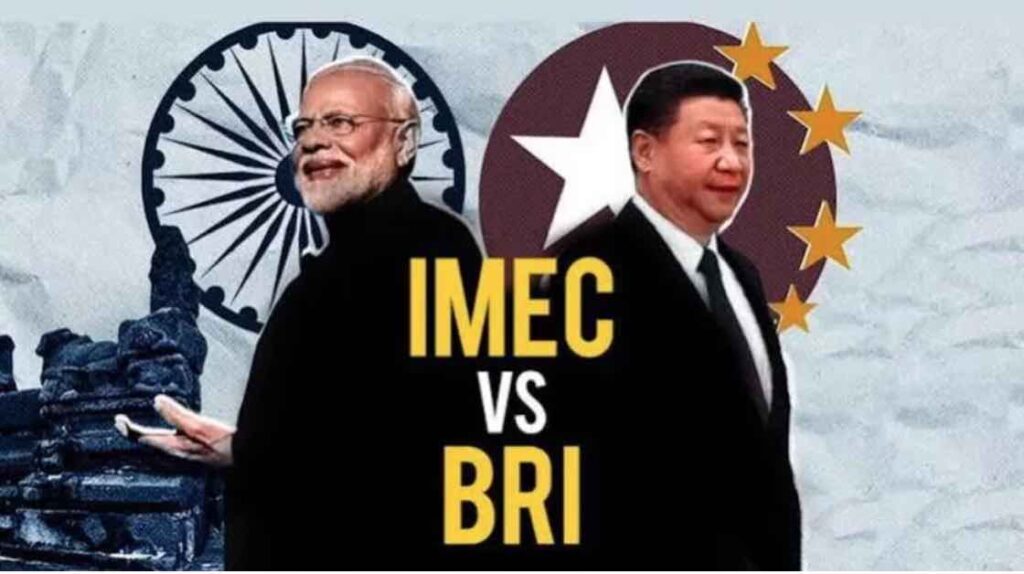
Trade maps are never neutral, especially at a delicate moment of deglobalization: behind every railway, port, or cable there is always a political choice, determining who finances it, who controls it, and, ultimately, who will depend on whom. This is why the comparison between the Belt and Road Initiative (BRI), China’s New Silk Road, and the India-Middle East-Europe Economic Corridor (IMEC) is not merely a matter of logistics. At the center of it all is Europe: the destination market, but also the arena in which two different visions of Asian power are competing.
China got there first. Since 2013, the New Silk Road has woven a network stretching from Asia to Africa and Europe: ports, railways, roads, energy infrastructure, and telecommunications. Beijing has deployed its state-owned banks and enterprises to finance and build infrastructure in countries controlling key nodes of global trade, from the China-Pakistan Economic Corridor to ports across the Indian Ocean, all the way to Piraeus and the rail links connecting China with Europe. The logic has never changed: to turn China’s financial and industrial power into a stable presence along global value chains.
India is following a different logic. It has neither a platform comparable to the Belt and Road Initiative in scale nor any intention of copying its centralized model. IMEC, announced at the 2023 G20 Summit in New Delhi, brings together India, the United States, Saudi Arabia, the United Arab Emirates, the European Union, France, Germany and Italy. On paper, it connects Indian ports to the Gulf, crosses the Arabian Peninsula by rail, and reaches the Mediterranean and Europe. Three years later, the comparison between the two projects shows precisely how trade routes have become tools through which great powers are reshaping the global balance of power: no longer simply a matter of logistics, but levers of influence, energy security and strategic projection.
The difference between the two projects, however, is not merely geographical. China enters strategic nodes through credit, construction projects and direct stakes in infrastructure. India, by contrast, is seeking to turn already solid political relationships into a shared connectivity system: the UAE brings logistics and capital to the table; Saudi Arabia contributes its railway network and Vision 2030 strategy; Europe provides the market, technology and regulatory standards. New Delhi, for its part, offers an enormous manufacturing base, digital expertise and rapidly growing demand for data. The result is certainly a more collective model, but also one that is far more complicated to hold together.
For Beijing, the geographical horizon is global: Central Asia, Russia, Africa, the Mediterranean, the Balkans and the maritime routes of the Indo-Pacific. Infrastructure is used to support exports, secure access to raw materials and consolidate political relationships. New Delhi takes a more targeted approach: it wants to overcome the geographical constraint imposed by Pakistan to its north-west, strengthen ties with the Gulf and secure faster access to Europe. It is no coincidence that India has stayed outside the Belt and Road Initiative, nor that it opposes the China-Pakistan Economic Corridor, which crosses territories in Kashmir claimed by New Delhi as its own.
IMEC, in short, is not simply an alternative trade route. It is also something more: the physical expression of India’s strategy of autonomy. To cooperate with the West without becoming its satellite; to compete with China without closing the door to dialogue; and to use its central position in the Global South as a bargaining tool. The conclusion of negotiations on the free-trade agreement between India and the European Union in January 2026 points in the same direction. If trade barriers come down, the question will no longer be simply how much is traded, but also which networks will carry goods, energy and data.
Geographically, IMEC is divided into two sections: an eastern maritime leg, running from India to the Gulf, and a northern land corridor that is expected to connect Saudi Arabia, Jordan and Israel to the port of Haifa, before continuing by sea towards Greece, Italy and France. Compared with the original version, the Atlantic Council has nevertheless estimated a designed Mediterranean outlet capacity capable of tapping into a potential non-oil trade market worth $331 billion, as well as more than 70% of the $135 billion in trade between India and the EU. The commercial promise is tangible: according to an analysis by Trends Research, the corridor could cut transit times for goods between India and Europe by 40% and costs by 30%, reducing the journey from the current 22–24 days to 12–14 days.
That said, the gap between the two projects remains enormous. The New Silk Road has been in existence for more than a decade and already has operational infrastructure on the ground, even though the transport component fell to 6.2% of the total in 2025, its lowest level ever — a sign that Beijing has shifted the initiative’s center of gravity towards energy, minerals and manufacturing. IMEC, by contrast, remains little more than a political framework, lacking a common authority, binding commitments, an overall budget, a finalized route and all the necessary rail connections. Moreover, its original route depends on a degree of stability in the Middle East that currently appears distant, as well as on cooperation between Saudi Arabia, Jordan and Israel — cooperation that the war has made far more difficult.
This very fragility could encourage India and the Gulf states to focus not on a single route, but on a network of alternatives: ports, digital cables and electricity interconnections can move forward even if the broader political agreement remains stalled. Ultimately, the real contest with China will not be decided by the announcement of a route, but by the ability to make it financially viable, interoperable and commercially attractive.
At this point, Europe faces a choice. It can settle for serving as the terminus for two competing Asian strategies, or it can use this rivalry to strengthen its own autonomy. European ports handle around 74% of the goods entering and leaving the Union and have become infrastructure of economic, energy and even military security. China’s control of Piraeus and its stakes in other ports have already demonstrated that an investment in a port is never merely a commercial transaction. But geography alone does not become an opportunity without a strong and targeted common EU commitment to securing functioning railways, digital customs systems, secure networks and a common European position on strategic investments.
China has built its influence by acquiring and financing strategic nodes. India is trying to build its influence by connecting different interests. The first path is further ahead; the second, if it succeeds in turning a political coalition into genuine infrastructure, could prove more balanced. For Europe, the challenge is not to choose between one dependency and another, but to remain in control of its own decisions while seizing the best opportunities for cooperation on both fronts. Because the routes of the future will not only determine where goods travel: they will also determine who gets a say in shaping the rules of global trade.