


The banking licence obtained in Mexico marks a decisive step: from a digital platform that can attract millions of customers to a financial infrastructure called on to show that innovation, sustainability, and inclusion can go forward together.
28 September 2026
The banking licence obtained in Mexico marks a decisive step for Nubank: from a digital platform that attracts millions of customers to a financial infrastructure set to demonstrate that innovation, sustainability, and inclusion can go hand in hand. Neobanks have built their success on a simple promise: smartphone-based services, lower fees and faster processes. Nu México, the Mexican subsidiary of the Brazilian group Nubank, is now taking that promise to the next level. Following authorisation from the Comisión Nacional Bancaria y de Valores on 10 July, it began operating as a commercial bank on 6 August, completing its transformation from its previous status as a SOFIPO – the popular finance company through which it had developed its business.
This is not a mere technicality. It marks the transition from an app that distributes financial products to a fully regulated bank, authorised to receive salaries, hold savings, offer credit and payment services, and become a person’s primary financial point of reference. Nu’s approach turns the traditional model on its head. Normally, a bank first obtains its licence, builds its infrastructure and then seeks out customers. Nu became fully operational after establishing its brand, launching a card with no annual fee in 2020 and expanding its offering to include a savings account, loans and secured cards. By April, it had surpassed 15 million customers; today it reports 16 million, representing over 16 per cent of Mexico’s adult population. This has been achieved without any branches, whilst maintaining a widespread presence in almost every municipality.
Within the emerging markets landscape, Latin American countries have carved out a leading role in the development of fintech, and Mexico is an extraordinary testing ground. The widespread use of smartphones coexists with a deeply ingrained reliance on cash, alongside large sections of the informal economy and regional and gender inequalities. According to the 2024 National Survey on Financial Inclusion, 76.5 per cent of people aged between 18 and 70 hold at least one formal financial product; this figure falls to 72.8 per cent among women and rises to 80.9 per cent among men. Only 63 per cent have a formal savings account, with a gap of almost 10 percentage points between women and men. Among those who hold an account, however, the use of mobile phones to check their account or carry out transactions has risen from 54.3 per cent in 2021 to 69.1 per cent in 2024. It is here that the Nu case takes on broader significance. Technology can bridge distances and reduce costs, but opening an account does not automatically equate to inclusion. An account fosters inclusion when it enables people to earn an income, save securely, make affordable payments, and access credit responsibly. And it fosters autonomy, particularly for women, when it strengthens personal control over resources without introducing new digital dependencies or opaque forms of exclusion.
Nu states that for 54 per cent of its customers, this is their first credit card, and that 60 per cent say they have started saving or increased their savings thanks to the platform. These are important indicators to consider alongside the quality of financial inclusion: how many customers are genuinely excluded, how they use the products, and whether credit helps them cope with unforeseen events without leading to over-indebtedness. Algorithms will also be decisive. Data analysis can assess people with a limited credit history, but it can also penalise those with irregular incomes, informal jobs, or profiles that deviate from the dominant models. Efficiency and personalisation therefore require transparency, data protection and the possibility of human review.
The licence, however, is not the end goal: the criteria by which Nu will be judged are changing. Until now, success has been measured primarily by the number of users. Now, what will count is the stability of deposits, credit quality, capital strength, anti-money laundering measures, cyber security and customer support. For a bank without branches, customer service is not an afterthought: it is part of the essential infrastructure. The real challenge will be to transform the breadth of the user base into the depth of the relationship. Owning a Nu card does not mean that Nu is one’s main bank. The breakthrough will come when more customers have their salaries paid into their Nu accounts, keep their savings there, and use more of its products; this evolution in the relationship makes the model sustainable and scalable, but it also increases the institution’s responsibility towards people’s financial well-being.
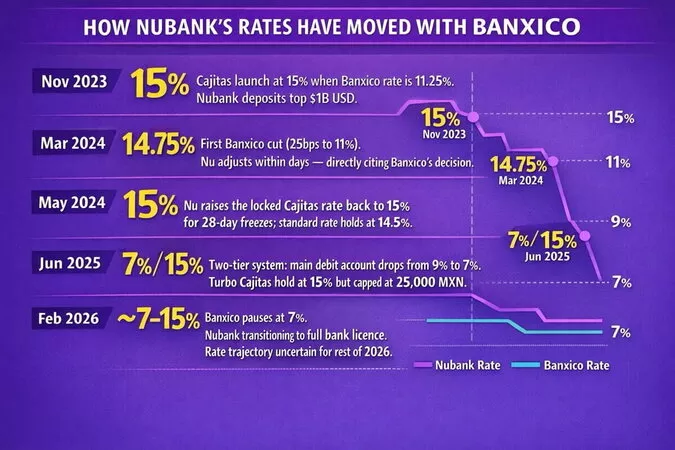
Competition, moreover, will accelerate the transformation of the Latin American banking system compared with the past. Revolut, which has been operating as a bank in Mexico since January, has surpassed one million customers in eight months and offers up to 15 per cent interest on savings: the gap with Nu remains wide, but the pressure on deposit costs is already very real. And September revealed the other side of growth in the fight against cyber-attacks: Revolut handed over the data of around 680 European customers to fraudsters posing as a public body, and one of its former suppliers was compromised. No systems were breached: it was people and third parties who let the defence down. Nu is not immune, as demonstrated by the attack on one of its debt collection suppliers in Colombia. From this perspective, the situation in Mexico is deteriorating. Banxico recorded eight cyber incidents in the financial system between January and May 2026, double the four recorded in the whole of 2025. There are, however, factors that mitigate the risk: in Mexico, formal requests from the authorities to banks generally go through structured channels via the CNBV, rather than via simple emails, so a ‘Revolut-style’ scam should be more difficult to pull off. Furthermore, Nu’s new status as a bank means it is subject to closer supervision.
The Mexican venture therefore extends beyond Nubank. The frontier of digital banking no longer lies solely in winning over customers, but in translating technological scale into trust, resilience and financial well-being. The licence opens up enormous possibilities and, at the same time, obliges Nu to maintain the simplicity of the customer experience whilst the bank’s complexity grows. It is by this balance – not merely by the number of accounts opened – that the success of the next phase will be measured.