

by Claudia Segre
THE BLOGGERS’ CORNER. It is no longer enough simply to incorporate it into governance models or sustainability reports: it must be measured, anticipated, and managed in a practical way
14 April 2026 at 11:36
“There are plenty more fish in the sea” is the title of Superflex’s installation at Palazzo Strozzi, which will address the issue of climate change. Yes, because, as I highlighted with the Credit Agricole case, following the ECB’s strong signal, one thing is now clear: climate risk is not something to be negotiated, but rather managed and capitalised upon, becoming a proprietary asset. So it is no longer enough simply to integrate it into governance models or sustainability reports: it must be measured, anticipated, and managed in an operational manner.
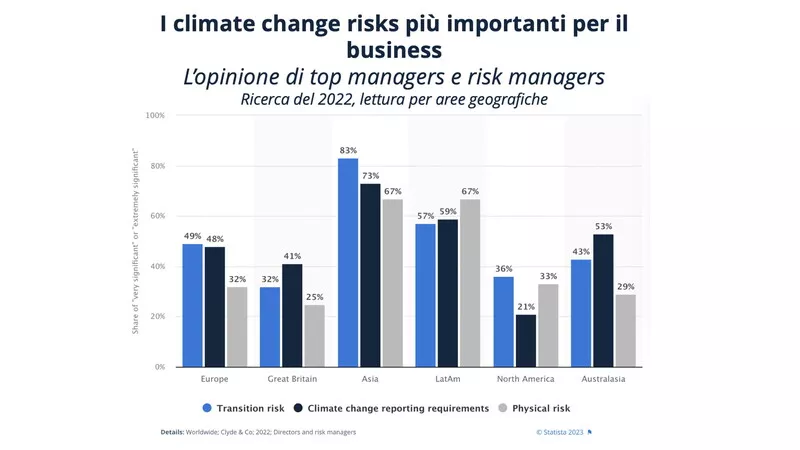
This shift is profound and crucial. Climate risk is no longer merely an environmental or reputational variable, but a structural component that affects credit quality, business continuity, industrial planning, and, ultimately, economic stability. It is no longer a matter of disclosure, but of competitive survival and social commitment.
In this context, ‘climate tech’ solutions are emerging that transform risk into data and data into decisions. This is the case with the AIRIS platform developed by Eoliann, a Piedmont-based start-up and benefit corporation, which integrates satellite data, machine learning algorithms and climate scenarios to simultaneously analyse six key risks (floods, landslides, fires, droughts, heavy rain and wind) across different time horizons and IPCC (Intergovernmental Panel on Climate Change) scenarios, assessing up to 72 risk dimensions for each asset.
As Roberto Carnicelli, Co-Founder and CEO of Eoliann, points out, “until a few years ago, climate risk was treated as a reputational or regulatory issue. Today, companies no longer ask ‘do we need to deal with this?’, but ‘how much will it cost us and when?’”. It is a clear cultural shift: climate risk has become a financial risk and, as such, requires quantitative tools. The real breakthrough lies in the ability to transform uncertainty into an operational metric. “A CFO or risk manager can finally put a figure on the table: the probability of a supply chain disruption, the expected economic loss, and therefore how much to invest in resilience.”
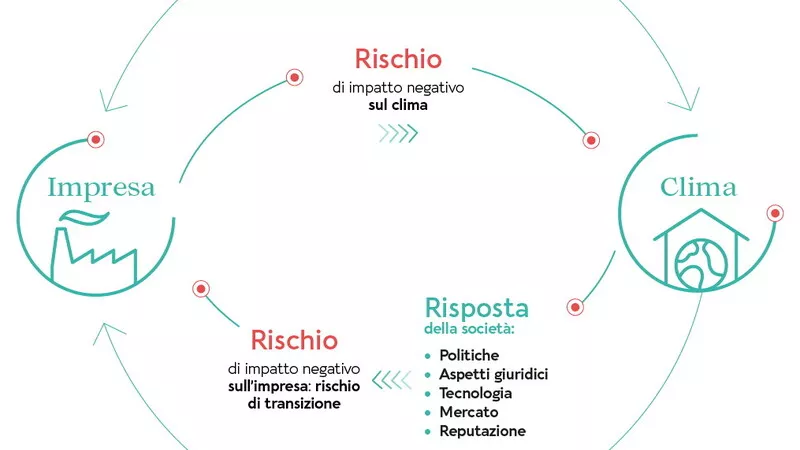
This approach introduces a crucial element: a systemic perspective. Climate change does not affect just one area, and analysing a single risk or a single time horizon means exposing oneself to unforeseen vulnerabilities. Integrating IPCC scenarios into decision-making models, on the other hand, makes it possible to test the robustness of business strategies in different contexts, whilst also strengthening credibility with investors and regulators. But measuring risk is not merely a technological issue. It is also, and above all, a matter of rights, equity, and the sustainability of local communities.
As Martina Rogato, Founder of ESG Boutique, points out, “climate risk is a multiplier of vulnerability that directly affects fundamental rights: health, water, food, work, and even the right to life”. Climate impacts are not neutral: they hit hardest those with the fewest tools to adapt, amplifying existing inequalities. This is why risk measurement must also incorporate the social dimension. It is not enough to ask how much a company stands to lose; we must also ask which communities are exposed, which workers are most vulnerable, and which regions risk being excluded from the transition. Otherwise, the risk is that everything is reduced to a compliance exercise. “If climate risk is treated as a regulatory checklist, the ethical and political dimensions are lost: compliance does not prevent damage, does not redistribute costs, and does not build resilience.”
This leads to a further paradigm shift: resilience is not just about adaptation, but also about responsibility. Businesses play a key role in building regional resilience through sustainable investment, strengthening local communities, and integrating climate risks into long-term decision-making.
And this has profound implications in terms of inequality as well: for whilst climate change inevitably exacerbates existing inequalities, it also highlights the central role of those who are often the most vulnerable and the least represented in decision-making processes.
In this context, financial choices also take on a new dimension. Allocating capital means deciding which economic models to support and which territories to protect. Integrating climate justice into finance means asking who benefits from investments and who is excluded. The point, therefore, is no longer whether climate risk should be considered, but how to integrate it into everyday decisions. The real challenge is not compliance, but the ability to transform complex data into responsible choices.
Carnicelli continues: “The World Resources Institute has estimated that every dollar invested in climate resilience generates an average of $6 in avoided costs – including physical damage, operational disruptions, and emergency response costs. This is not rhetoric: it is a measurable ROI. Companies investing in resilience today are building a three-pronged advantage. First, operational continuity: those who have mapped and mitigated their physical risks will be less vulnerable to the shocks that will hit unprepared competitors. Second, access to capital: ESG and climate disclosure are becoming prerequisites for certain types of financing – those with credible data secure better terms. Third, relationships with customers and partners: large corporations are passing on resilience requirements throughout the supply chain. Being a ‘climate-ready’ supplier will not be a bonus; it will be a prerequisite for entry. Resilience is not a cost to be managed: it is an investment with a clear and demonstrable return. And so resilience is no longer just a technical response: it is a new form of economic governance. It concerns businesses, institutions, citizens, and the future of the regions we inhabit – regions that guarantee our quality of life and economic sustainability.